Living in Community for God

Living in Community for God

Living in Community for God

1 Peter 4:1-11

The older I get, the more interested I am in making sure that I am living my life to the fullest for God. When I was young, it seemed that time went by slowly and I was always waiting for what was next. Now that I am older, times seems to fly by and I am constantly wondering where the time went. In the passage before us, Peter describes four attitudes a believer should have to make the most of the time they have. As you read about these attitudes, ask yourself if you have these attitudes present in your life and what adjustments you may need to make to live your life to the fullest for God.

Righteous Attitude Toward Sin 1 Peter 4:1-3

Peter encourages the reader to have a righteous attitude toward sin. “Therefore, since Christ suffered in His body, arm yourselves also with the same attitude, because He who has suffered in His body is done with sin.” (1 Peter 4:1) Remembering what Christ did in His own body to pay for the penalty of our sins helps us combat the sin that is present in our own lives. The person who remembers Christ’s great sacrifice on the cross does not live to satisfy the evil desires of the flesh, but lives to fulfill the will of God. Peter reminds us that we spent too much time living as “pagans” before we received Christ. He lists the prevailing sins of the day to make a contrast between the “pagan” lifestyle and the believer’s lifestyle. Nothing will sabotage the time that we have to live for God more than sin. In light of what Christ did for us on the cross, why would we want to return to a sin-filled life?

Understanding Attitude Toward the Lost 1 Peter 4:4-6

I was twenty when I received the gift of eternal life that Jesus offers those who will trust Him. The change in my life was dramatic and noticed by my family and friends. Many of them did not understand why my life style changed so dramatically and why I was so passionate about the things of God. Peter describes the need for a understanding attitude toward the lost. He writes, “They think it is strange that you do not plunge with them into the same flood of dissipation, that they heap abuse on you.” (1 Peter 4:4) They too will be judged for the way they live their lives and what they do with Jesus Christ. The truth is they don’t understand because they don’t believe. Having an understanding attitude will not only help you stand up to their abuse, but you will have opportunities to be a light for Christ in a very dark world. Take every opportunity to minister to those who do not know Jesus. Time is too short to miss these divine appointments.

Expectant Attitude Toward Christ’s Return 1 Peter 4:7

Since time is short, we should have an expectant attitude toward Christ’s return. Peter writes, “The end of all things is near. Therefore, be clear minded and self controlled so that you can pray.” (1 Peter 4:7) The early church expected for Christ to return during their lifetime. Every day that passes is an opportunity for us to minister to those around us. When Christ comes back, it will be too late. The truth is that we will all see Jesus one day. We don’t know when, but we know it is closer today than it was yesterday. The quality of our lives today will determine our reward on the day we see Jesus face to face.

Servant’s Attitude Towards Others 1 Peter 4:8-11

The final attitude Peter encourages the reader to have that is described in this passage is a servant’s attitude toward others. He encourages love, hospitality, and the proper use of our gifts. Rick Warren, the pastor of Saddleback Church in California, describes the unique ministry S.H.A.P.E. that God has given each one of us.

  • S – Spiritual Gifts
  • H – Heart
  • A – Abilities
  • P – Personality
  • E – Experience

The unique blending of these five areas of our lives equip us for a the unique ministry God has for each one of us. Peter goes on to emphasize that our gifts should be used for the glory of God, not ourselves. This will ensure that God receives His proper glory. Peter ends this passage with a fitting doxology, “To Him be the glory and the power forever and ever. Amen.

Pray the Pledge

Pray the Pledge

Pray the Pledge

I pledge allegiance to the Flag of the United States of America,

Thank God for our country and the blessing of being a citizen of the greatest nation the world has ever known.

and to the Republic for which it stands,

Pray for the political process as we elect those who will represent us.

one Nation under God,

Pray that our nation would return to God. 2 Chronicles 7:14

indivisible,

Pray for unity for our nation as the political debate continues.

with liberty and

Thank God for the religious liberty that we have and ask Him to preserve that liberty.

justice for all.

Pray for justice for all Americans including the unborn, elderly and defenseless.

Living Without Fear

Living Without Fear

Living Without Fear

1 Peter 3:13-22

When a commitment is made to teach through the Bible verse by verse, there are going to be times when the teacher arrives at a passage that is difficult and defies simple explanation. 1 Peter 3:13-22 is one of the most difficult passages in the New Testament to interpret and teach. We may not be able to solve every problem presented by this passage, but we can find a source of hope in difficult times, which is Peter’s theme for this letter.

Peter starts this passage with a question, “Who is going to harm you if you are eager to do good?” (1 Peter 3:13) This verse immediately follows the direct quote of Psalm 34:12-16. If a person seeks to love life and see good days as Psalm 34 describes, who will harm them? It is unlike that an individual who lives a righteous life will be persecuted for doing good. Peter encourages the reader that if suffering does result from a righteous life, they will be blessed. Peter was there when Jesus preached the Sermon on the Mount and said, “Blessed are those who are persecuted because of righteousness, for theirs is the kingdom of heaven.” (Matthew 5:10)

With the possibility of suffering for doing good, Peter calls the reader to not fear or be frightened. Two forms of protection are given to defeat fear. The first is to “set apart Christ as Lord,” in your heart. In the Bible, the heart represents the spiritual center of man. When the center of one’s life is rightly focused on God, he is able to defeat fear and live victoriously for Christ. Christ is Lord of our lives. He is in control, and by his grace He will not allow us to face any situation that He will not provide us the strength we need to find hope.

The second solution for fear is preparation to defend the hope we have as believers in Christ. (1 Peter 15) In order to defend the hope we have, it is necessary to understand the depth of Christ’s love for us and what that means to us on a personal and practical level. When a believer is firmly grounded in the Word of God, has experienced the grace of God through Christ, and can explain this hope to those who would ask, they are well on the way to defeating fear and being confident believers who can find hope in every situation. Peter encourages the reader to give this reason with gentleness and respect, and with a clear conscience.

Jesus is the supreme example of suffering for doing good that brings God glory and salvation to man. Peter writes, “For Christ died for sins once for all, the righteous for the unrighteous, to bring you to God.” 1 Peter 3:18 This is the good news about Jesus in one verse. It is by Christ’s death, burial, and resurrection from the dead that we can have eternal life.

As Peter is describing the death and resurrection of Christ, he describes an event where Jesus “preaches to spirits in prison who disobeyed long ago when God waited patiently in the days of Noah while the ark was being built.” These verses about this preaching event are difficult and should not take the focus off the hope a believer can have in Christ. It is helpful to answer three questions about this event: 1) To whom was Jesus preaching? 2) When did this event take place? and 3) What was the content of the message?

First, the passage describes the recipient of the message as “spirits.” This is a term reserved to spiritual being like angels or demons. This term would not be used to describe the spirit of man. Peter uses the word “spirits” to describe angels or demons and “souls” to describe man. This message was preached to spiritual beings in prison; fallen angels who were connected to the sin in Noah’s day.

Secondly, when did this event take place? There are two main ideas about the timing of this message to fallen angels. This proclamation took place either during the three days between His death and resurrection or during His ascension. Whichever time it was has the same effect. Jesus made a proclamation to the fallen angels after His death on the cross.

Finally, what was the content of Jesus’ message? Peter does not tell us the content of Jesus message to these imprisoned spirits. We do know that it was not a message of redemption, since angels cannot be saved (Hebrews 2:16). Since this message is linked to the resurrection, we know it was a message of victory over Satan. One can imagine the resurrected Lord strongly proclaiming His victory to these imprisoned spirits in a loud victorious battle cry.

To summarize this difficult passage: After Christ died on the cross and was resurrected, He made a victorious proclamation to fallen angels. (Jude 6)

In the remainder of this passage, Peter uses the symbol of baptism to bring hope to the reader by reminding them of their salvation. Baptism is a picture of the death, burial, and resurrection of Jesus Christ. In the same way, the flood pictures death, burial, and resurrection. The waters buried the earth and lifted the ark to safety. The ark is a symbol of the salvation that God provided for Noah and his family. They were saved from the flood by placing their faith in God as He provided a way of salvation from the rising waters. Sinners, in the same way, are saved by faith in God as they trust Christ, God’s provision for the penalty of sin.

It is important to emphasize that baptism does not save anyone. It is a faith relationship with Jesus, that baptism represents, that saves. The symbol should not be confused or substituted for what it symbolizes.

Clear Application for Today

  • Teaching verse by verse through the Word of God is both challenging and rewarding.
  • As we live for God, we should not look for suffering, but when it comes, we should trust God with the details of our lives.
  • In our hearts, we should set apart Christ as Lord.
  • We should be prepared to give an answer to everyone who asks us to give the reason for the hope that we have.
  • We should marvel at what Christ did for us on the cross.
  • Baptism is an important symbol of our salvation relationship with Christ.
  • Jesus is at the right hand of the Father with all of creation in submission to Him. We are His prize possessions!


Living at Home

Living at Home
Living at Home

1 Peter 3:1-12

God has instituted a precious relationship between a husband and his wife that is under attack in our culture. Attempts to redefine marriage and the practice of cohabitation before marriage are examples of this attack. This attack can be overcome by turning to the Word of God for truth. The marriage relationship is the focus of 1 Peter 3:1-9.

Peter continues his theme of submission to authority that he started in 1 Peter 2:12. He has stated that believers should be submissive to governmental leaders and employers using Christ as our supreme example. Now he focuses his attention on those closest to us, our mates. Married couples have a choice to make: Live life conforming to the trends and patterns of this world or honor God and follow His pattern for marriage.

Peter starts by addressing wives and encourages them to be submissive to their husbands. In our society, this idea is becoming more and more foreign to our way of thinking. A wife demonstrates her faith in God by submitting to their husbands. She also is a mighty instrument of ministry to her family when she lives a life of “purity and reverence.” Peter indicates that the husband who is lost can be won to Christ by the godly life of his wife. There is great power in living a righteous, Christ-centered life.

In this passage of scripture, Peter also identifies the source of a woman’s beauty. He contrasts a woman who seeks beauty in outward adornments, braided hair, gold jewelry, and fine clothes with a woman who seeks “inner” beauty that comes from a gentle and quiet spirit. A woman of “inner” beauty is of great worth to God. Peter does not condemn paying attention to dress and fashion, but does communicate that is not ultimately the source of true beauty that God honors.

In verse 8, Peter challenges husbands to be considerate to their wives, respect them, and provide protection for them as the weaker partner. This again is counter cultural and foreign to our current way of thinking. God has instituted an order to the marriage relationship. Men are to be the spiritual head of the household and provide for and protect their wives. Husbands and wives are equally important to God with different roles within the family. Peter indicates that both husbands and wives are heirs of the gracious gift of life that Jesus offers.

A man’s relationship with God is influenced by the quality of his relationship with his wife. Peter says, ” . . . . so that nothing will hinder your prayers.” (1 Peter 3:7) This passage shows that a man’s prayers are hindered if his relationship with wife is unhealthy, which shows the importance of our marriage relationship. Read Ephesians 5:22-33 for more scripture on the theme of submission in the marital relationship.

Finally in 1 Peter 3:8-9, Peter addresses all believers to:

  • live in harmony with one another,
  • be sympathetic,
  • love as brothers
  • be compassionate and humble,
  • not repay evil with evil, and
  • not return insult with insult, but with blessing

This type of life leads to blessings.

Peter finishes this thought by quoting Psalm 34: 12-16 that focuses on the way we can “love life and see good days.”

Living Under Stress

Living Under Stress

1 Peter 2:18-25

Are you stressed? Do you feel pressure? Everyone feels the pressures of life that causes stress. What we do with these pressures determines our health and the extent that we honor Christ with our lives. There are both good and bad stresses.

Good stress occurs when we exercise or challenge ourselves mentally or emotionally. Rising to the occasion to make a difference in someone else’s life brings stress. Take for instance the paramedic who arrives on the scene of an accident to administer CPR just in time to save a life, the soldier who puts himself in harm’s way to protect the freedom we enjoy, or the counselor who says just the right thing, at just the right time, that helps someone deal with life’s pressure. I am thankful for those who intentionally put themselves under pressure for others. This is the good side of stress. What are other examples of good stress?

Most of the time when we mention stress we are describing negative stress and its effects. Bad stress occurs when the pressures of this life lead to a helplessness and depression. Job related pressure, financial stress, and relational stress are all examples of negative stress we all experience. Since we all deal with the stresses of this life, good stress or bad stress, we must develop strategies to cope with stress that both honor Christ and lead to a healthy life. Every stressful situation we encounter is an opportunity to place our faith in God.

In 1 Peter 2: 18-20, Peter describes two situations a believer can get into that cause pressure: Stress in the workplace and stress in walking in the steps of Christ. This passage occurs as Peter is writing about the need for submission in the believer’s life.

Stress in the Workplace 1 Peter 2:18-20

Peter is writing in a day where slavery was common. His instruction is focused on slaves responding to their masters. Since we live in a society where slavery is illegal, we can apply the principles found in this passage to employees responding to their bosses. Peter instructs the reader to “Submit yourselves to your masters with all respect, not only to those who are good and considerate, but also to those who are harsh.” The principle of submission, although not popular, is the key ingredient to the employee / employer relationship. This submission is to take place with employers who are good and those who are difficult. It is easy to submit to an employer when we agree with them. Submission is tested when we don’t agree with the boss or feel their course of action is unfair. In this passage, Peter calls the believers in Christ to submit to and honor their employer.

In our working situations and in life, living a life that honors God and doing good will cause stress and suffering. When you think about it, if we are living as aliens and strangers in this world as 1 Peter 2:11 describes, it makes sense that there will be stress because of the uniqueness of our lives. The second stressor that Peter mentions in this passage is the stress that we encounter when we walk as Jesus walked.

1 Peter 2:21-25 shows that Jesus is our Example and that we must follow in His Steps. Peter paints three pictures of Jesus Christ that will help us understand how we should respond to stress and suffering.

He is our Example  1 Peter 2:21-23

Jesus suffered for us when He died on the cross for our sins. How he handled the lies, false accusations and shame of the cross set us a supreme example of how we should endure the suffering of this life. 1 Peter 2:23 says, “When they hurled their insults at Him, He did not retaliate; when He suffered, He made no threats. Instead, He entrusted Himself to Him who judges justly.” This is the key! When stress and suffering comes, we have an opportunity to trust God with the circumstances. We will find that He is faithful. It is during these times that our faith will grow beyond the place it can during peaceful times. Jesus endured the cross because it was the will of God and because of His great love for us. God’s will and our love for Him will motivate us too.

He is our Substitute  1 Peter 2:24

Jesus’ death on the cross provided a way that we can be saved. We can die to the old way of life and live lives of righteousness. His wounds healed us! If you have a relationship with God, never forget that Jesus has the power to heal our wounds.

He is our Shepherd and Overseer of our soul  1 Peter 2:25

Peter concludes this passage by comparing us to sheep. Sheep are defenseless, hopeless, and completely dependent on the shepherd for their well being. John 10:1-14 and Psalm 23 are great examples of our need for a Shepherd. He is the Shepherd of our souls who will never fail.

What stress or struggle in your life do you need to give to Jesus?

Remember our Savior, who is our ultimate Example.

Living as Strangers

Living as Strangers

I Peter 2:11-12

A person who has placed their faith in Jesus Christ as their personal Lord and Savior becomes a resident of Heaven and becomes an alien of this world. As aliens, there are challenges that come with living “in” this world and aligning our action as someone not “of” this world. In 1 Peter 2 through the end of the letter, Peter describes how we can thrive in this world as we look forward to our place in Heaven.

In 1 Peter 2:11, Peter strongly encourages the reader, who is an alien in this world, to abstain from “sinful desires that war against your souls.” There is an active battle raging for the minds and souls of men. Peter has already shown the security of the believer in 1 Peter 1:5. Even in the life of a believer, there is a battle between the way we should live and the sinful desires within us. As we abstain from these sinful desires, we will have a powerful witness with those we come into contact with.

Our lives, when lived for God, become a witness and an opportunity to glorify God. Peter writes, “Live such good lives among the pagans that, though they accuse you of doing wrong, they may see your good deeds and glorify God on the day he visits us.” 1 Peter 1:12 Wow! The way we live our life matters. Peter is writing about a life that is above reproach, meaning that if someone tried to find something to accuse you of, they would be unable to find anything. This type of clean living has a direct effect on our witness. We validate or invalidate our witness with the actions of our lives. The good deeds of our lives become evident to those around us that lead to praise and glory for God. This is a demonstration of who we are in Christ, a new creation with new desires.

People are watching you. They want to know if your lifestyle matches what you say you believe. They want proof that there is a difference in the life of a believer when compared to the life of a “pagan.” Could it be that we are reluctant to speak for Christ because our lives contradict what we know to be true?

Clear Application for Today

  1. Realize that there will be a struggle as you live as an alien in a hostile world.
  2. Declare war on the sinful desires that rage in your life. 2 Corinthians 10:5
  3. Confess sin, receive God’s forgiveness, and pray for God’s strength to live the “good life” Peter is writing about.
  4. Look for opportunities to share the good news about Jesus with those whom you come in contact with.
Family Matters

Family Matters

Family Matters

I Peter 2:1-10

1 Peter 1: 3 says, “Praise be to the God and Father of our Lord Jesus Christ! In his great mercy He has given us new birth into a living hope through the resurrection of Jesus Christ from the dead,”. In the first part of Chapter Two, Peter continues to give the reader reasons we have for hope.

Peter starts by instructing the reader to rid themselves from malice, deceit, hypocrisy, envy, and slander. These vices keep the child of God from living a hope-filled life that honors God. He then goes on to encourage them to “crave pure spiritual milk”. (1 Peter 2:1-3) God’s Word is the source of spiritual nourishment that the believer needs to experience new, hope-filled life. If a child of God stops feeding on the Word, he becomes unhealthy and stops growing. This keeps him from enjoying the grace and peace of God working in his lives. The child of God who feasts on the Word gets the spiritual nourishment needed to live as a stranger in this world and live in the hope that new life in Christ brings.

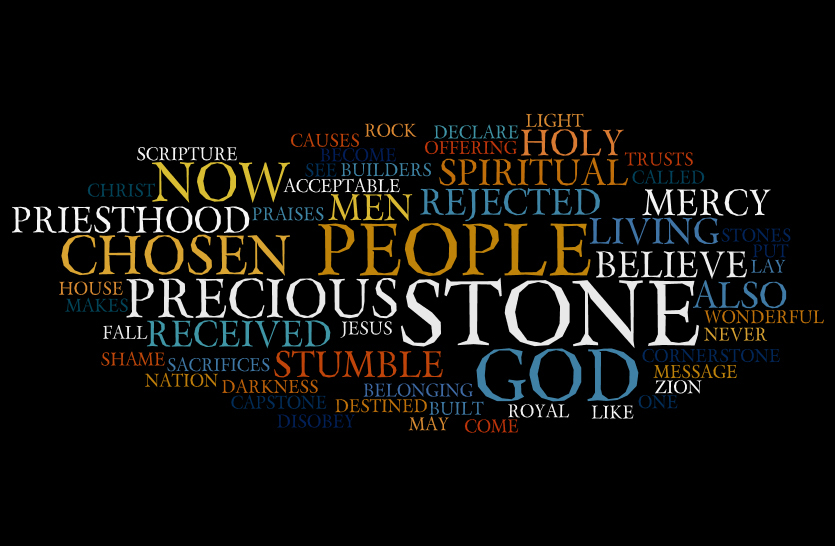
The next reason that Peter gives for hope is that we can take our place in the building God is constructing – the Church. (1Peter 2:4-8) Jesus is described as the living stone because He was raised from the dead on the third day. He is now the foundation for the church. (Matthew 16:17-19) We take our place in the church as we act as priests and offer God spiritual acts of worship. (Romans 12:1-2) For those who do not believe and are unwilling to worship Him, Jesus becomes a stumbling block.

Finally, Peter describes our place as God’s children in the People of God. Peter is very careful with His description of God’s people. 1 Peter 2:9 describes the child of God as a “chosen people, royal priesthood, a holy nation, a people belonging to God, that you may declare the praises of Him who called you out of darkness in His wonderful light.” When we understand who we are in Christ and the place we have in the “people of God”, we will gain strength for our journey and find hope for hard times.

Clear Application Questions for Today

  1. Do you hunger for the “pure spiritual milk” of the Word of God? What adjustments do you need to make in your life to make more time to get into God’s Word?
  2. Do you actively serve God and offer him the worship He deserves? What evidence is there in your life that you belong to the “People of God”?

Do you understand your place in the “people of God.” Read 1 Peter 2:10 to be reminded on the change that has happened in your life.

A Letter of Hope

1 Peter- A Letter of Hope

This week we begin a new study through the book of 1 Peter. The apostle Peter wrote this book to encourage the Christians of his day who were experiencing persecution because of their faith. Although we are not yet persecuted for your faith in our context, 1 Peter has words of encouragement for us in our time and our culture.

The epistle starts off by identifying Peter as the author and believers who find themselves as aliens in a world hostile to Christianity as the recipients. Throughout the book, Peter exhorts believers to remain faithful and trust God no matter their circumstances.

In 1 Peter 1: 3-9, Peter writes about the reasons we have to praise God:

1. We should praise Him because His mercy has provided a way of salvation and new birth by the resurrection of Jesus Christ from the dead. 1 Peter 1:3

2. We should praise Him because of the promise of an eternal inheritance that is “imperishable, uncorrupted, and unfading.” 1 Peter 1:4

3. We should praise Him because there is a place in Heaven for all who will believe. 1 Peter 1:4

4. We should praise Him because we can be eternally secure. 1 Peter 1:5

5. We should praise Him because He brings purpose to the trials that we face on this earth. We praise God by how we handle the hard times of our life. When trials come, they are opportunities for us to place our faith in God and glorify him in our time of need. 1 Peter 1:6-7

6. We should praise Him because following and loving Christ leads to joy that is unexplainable. 1 Peter 1:8

7. We should praise Him because the outcome of our faith will be the salvation of our souls. 1 Peter 1:9

He deserves our praise!


Kinsman-Redeemer

In Ruth, chapters 2-3, there is a great love story recorded about the widowed Ruth and her kinsman-redeemer, Boaz. This is a beautiful account of grace, love, and redemption. This account can be seen as a representation of our relationship with Jesus Christ. Understanding the details of the love story of Ruth and Boaz helps us understand the love relationship we can have with our Savior, Jesus Christ.

Ruth and her mother-in-law had traveled back to Bethlehem after their husbands died. They were in a tough situation and needed to find a way to survive. Ruth began gleaning in Boaz’s field where she met Boaz face to face. Boaz was kind to Ruth and provided safety and food. Once Naomi hears that Ruth met Boaz, they develop a plan for Ruth to offer herself to Boaz. Ruth must prepare herself as she goes to Boaz. This preparation is also how the believer prepares themselves to be acceptable to a holy God. These are the five things Ruth did before going to Boaz:

  1. Ruth washed herself. Ruth 3:3 – In order to be acceptable to God, we must cleanse ourselves from the sin that displeases God.
  2. Ruth anointed herself. Ruth 3:3 – This is a picture of a bride getting ready for her groom. We are called to be the “fragrance of Christ” by our character and conduct. These are the decision we make as we live for Him.
  3.  Ruth changed her clothes. Ruth 3:3 – In the Bible, clothing has a spiritual meaning. Salvation is pictured as putting off the “old self” and putting on Christ.
  4. Ruth learned how to approach her Redeemer – Ruth 3:3-4 – Naomi instructed Ruth about how to offer herself to Boaz. Approaching him in the wrong way would be a deal breaker. Ruth approached Boaz by lying at his feet. We approach Christ by kneeling at His feet and placing our faith in Him and what He did to redeem us.
  5. Ruth acted on what she knew was true. – Ruth 3:5 – Ruth did not only listen to Naomi, she did what she said. In the same way, we must be doers of the Word, not just hearers only.

God wants to cleanse our sin so that we become the fragrance of Christ. We do this by placing our faith in Jesus Christ and putting off our “old self” and putting on the garments of Christ. This allows us to approach God with confidence as we strive to live a life that honors God.

Ruth

Hope, Love and Redemption

The book of Ruth in the Old Testament is a compelling story that contains hope, love and redemption.

During the time of the Judges, there was a famine in the land. The book of Ruth is the story of Naomi and Ruth making a pilgrimage back to the Promised Land where they encounter their Kindsmen-Redeemer, Boaz.

Elimelek, Ruth, and their two sons traveled to Moab to find food during the famine. While they were in Moab, their two sons married Moabite women named Orpah and Ruth. After the father and two sons die Naomi, Orpah, and Ruth are widows with a bleak future. Naomi decides to return to Bethlehem. During this journey Naomi tells her daughter’s-in-law to return to Moab where they can remarry and live out peaceful lives. Orpah decides to return, and Ruth refuses by expressing her commitment to Naomi and to her God.

Ruth 1:16-17 says,

16 But Ruth said, “Do not urge me to leave you or to return from following you. For where you go I will go, and where you lodge I will lodge. Your people shall be my people, and your God my God.
17 Where you die I will die, and there will I be buried. May the Lord do so to me and more also if anything but death parts me from you.”

This amazing confession represented Ruth’s commitment to her mother-in-law, Naomi, and a decisive rejection of the pagan religion of the Moabites. This is a bold statement of her faith in the God of Israel.

When they arrive in Bethlehem, Ruth begins gleaning in a field owned by Boaz. Ruth has a face to face conversation with Boaz which starts the most famous love story found in the Bible.

This love story becomes a representation of Jesus Christ and His relationship with His bride, the church. Like Ruth, we are lost and outside the covenant family of God. We are bankrupt with no hope of God’s mercy. But God took the initiative and provided a way for us to enter His family through faith in Jesus Christ. (Ephesians 2:8-9)

Clear Application for Today

  • Commitment to family is valuable.
  • God blesses hard work.
  • God blesses His children in the midst of their circumstances.
  • God provided a Redeemer, His name is Jesus!